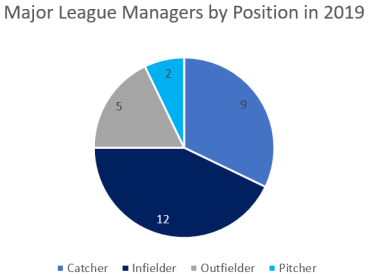
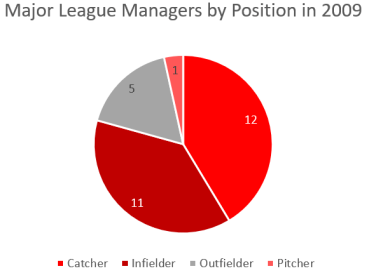
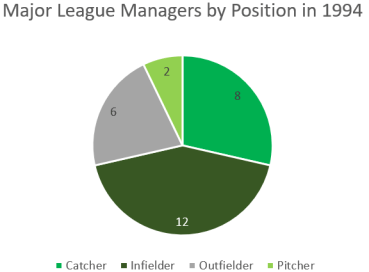
25 years ago, 8 out of 28 managers in the MLB were former catchers. The youngest active manager in 1994? Buck Showalter, still managing in 2018. Just thought that was fun. Going into 2019, there are 29 teams with managers named, while the Orioles are still searching, there are at least 9 managers who were former catchers (I can’t find what position Mike Shildt of the Cardinals played, he never played professionally). So why do I say there is a rise in non-catcher managers? In 2009, there were at least 12 managers who were former catchers (I couldn’t find Dave Trembley’s playing position, then manager of the Orioles, and Ken Macha, managing the Brewers in 2009, was originally a catcher but moved to third base as he got closer to the MLB and rarely caught in the majors). So there was a trend for awhile of former catchers managing, but it appears that may be reversing. With former non-catchers such as Rocco Baldelli, Charlie Montoyo, David Bell and Chris Woodward being hired as first time managers this offseason, it appears that catchers may be continuing to be on a downswing in the managerial department. Maybe it’s just chance, a cycle of careers that will rise and fall among former catchers. But maybe it’s something more. Maybe it’s these former players, who may have at other times been hitting or fielding coaches, insisting on being minor league managers to get to the position they wanted eventually of managing a major league team. The success of non-catcher managers, especially those that are new to their jobs, may ensure that former pros who’ve gained the respect of the higher ups in their organization may outweigh catchers who, despite working closely with managers to call games, may not have the same aptitude for running a team.
Success of Non-Catchers
This year, 4 out of 10 playoff teams had former catchers as managers, which makes you think that former catchers were doing great. However, 3 of those 4 teams (Cubs, A’s, Braves) didn’t make it past the divisional round, with the Cubs and A’s both getting knocked out in the Wild Card Game. The Astros, with AJ Hinch, were the only team competing in a LCS this year with a former catcher as their manager. The Red Sox, Dodgers, and Brewers not only had non-catchers, but young non-catchers with a lot of their career still ahead of them. Dave Roberts of the Dodgers was in his third year as a manager, and the Dodgers have won the NL West every year he’s been at the helm, finishing their season no earlier than the NLCS in that time. The Brewers’ Craig Counsell was in his 4th year, 3rd full year, with the Brewers, who have improved by no less than 5 games with each year further into Counsell’s tenure. Alex Cora became just the second rookie manager to ever win a World Series when his Red Sox defeated the Dodgers in the fall classic. It was the first time since 2013 that a team who’s manager wasn’t a former catcher won the World Series (also the Red Sox, then under John Farrell), and the first time since 2011 that neither World Series team had a former catcher running the team. The Dodgers, Brewers, Red Sox, and Yankees aren’t likely leaving their posts as some of the top teams in baseball soon, and their young managers, including Aaron Boone of the Yankees, a former third baseman, are likely going to stick around as well, so we could be looking at more playoff success for non-catchers in the near future.
Youth
13 of the 29 managers going into the 2019 MLB season will be under 50 years old (again Orioles manager still vacant). Of those, just 3 are former catchers, and the oldest in that group, Brad Ausmus, will turn 50 on April 14th of 2019. So 10 young managers are non-catchers. But not all young managers will have long careers, so let’s look at how successful they’ve been. 3 of the non-catchers on this list have yet to manage a game (Baldelli, Bell, Woodward), while some others (Gabe Kapler and Mickey Callaway) inherited rebuilding teams in 2018, and Kapler’s Phillies impressed as they fought to stay in the playoff hunt most of the season before fading down the stretch to an 80-82 record that still outreached what just about anyone had projected them. The other managers who were rookies in 2018 were Alex Cora and Aaron Boone, whose Red Sox and Yankees both won 100 games, the first time in MLB history 2 teams in the same division have done so, and Cora’s Sox won the World Series. Both seem like they’re good bets to have long successful careers if their first year is any indication. The other 3 non-catchers in this group are Dave Roberts, Craig Counsell, and Andy Green. Roberts has had nothing but success in his time managing the Dodgers, with back-to-back World Series appearances in ’17 and ’18, and Counsell, as mentioned above, has led his team to improvement each year. Green, however, has struggled with a Padres team that simply lacks talent. That said, in his three years as manager they have yet to lose fewer than 90 games, a number that will likely have to change in 2019 for him to keep his job there. He turns 42 in July, so if he finds success he could still have a long career ahead of him. Overall, there are at least 5 of these 10 young managers who still have a long time remaining as managers in this league if they should so choose. Of the three catchers, AJ Hinch has done very well with the Astros, including a World Series Title in 2017, Kevin Cash has led the Rays from a 68-94 record in his second year in 2016 to a 90-72 record in 2018 despite sharing a division with the dominant Red Sox and Yankees. Brad Ausmus struggled in his 4 years with the Tigers, inheriting a team that had won 3 straight division titles and leading them to a 4th his rookie year, and then the team just fell apart. They were swept in the ALDS in 2014 before a horribly disappointing 74-87 2015 season. They rebounded to 86-75 in 2016 but were still not really in the playoff hunt and started trading away talent in what led to a 2017 record of 64-98 that tied for the worst in the MLB and Ausmus was released by the Tigers. The Angels are hoping he is a better fit for their team, with plenty of talent (see Mike Trout, AL Rookie of the Year Shohei Ohtani, future hall of famer Albert Pujols), yet have failed to make the playoffs each of the last 4 years.
Leadership
Calling a game is important. It’s the main thing that the public sees managers do. But managing the locker room is just as important. The idea of players giving up on coaches or fighting for them is dependent on them liking playing for them or at least respecting them. With the rise in an analytically run game, managing a game is less and less about a gut feeling about who to put where, what pitchers to bring in when, and what to throw each batter, and more about evaluating what the numbers say. If the numbers say a player hits to the right side 4 times as often as he does to the left side, you put the shift on to try to take away what that batter is best at. If a batter has an OPS of .800 against right handed pitchers, but only .650 against lefties, in a high pressure situation you bring in a lefty, even if it’s a right-handed hitter. The in-game managing of a baseball game has been so changed by the rise of analytics that these choices are no longer as important to a managerial career than they once were. What is important is getting the most out of your players. Getting the right staff to help you, from your bench coach to your hitting coach to your bullpen coach. More and more, front offices are evaluating manager applicants by how respected they are/were by their peers in coaching and playing roles. If players don’t view their manager as a good leader, or think that they’re making decisions that are detrimental to the team, that’s likely to affect their mentality towards the game. Teams can’t afford to lose games because their players’ mentalities aren’t right, and if that’s caused by a manager, they’ll get rid of them in a hurry. Managing a team full of professional athletes who are some of the best people in the world at what they do is a difficult task, and done improperly, can result in overwhelming failure for the franchise.
So many teams are getting ready for the future with young managers who played their highest level as left fielders, third baseman, pitchers, shortstops, and yes, some catchers. But it appears that a full catcher takeover, such as having half of all MLB managers be catchers, won’t quite happen. Teams look more for respected locker room presence than game calling skills now more than ever, reducing the advantage catchers have over others. Catchers may remain more common than any other individual position, but that lead looks like it may dwindle away as analytics run the game as much, if not more, than people do. For now, I’m excited to watch these young managers get a chance that may not have been given to them in another time, when they may have been pushed into hitting, fielding, or base-running coaching roles. Until next time,
CM
Stats and info courtesy of baseball-reference.com
 Murphy's Field
Leave a comment