
It’s 1989. 25 out of 106 schools playing FBS (then Division 1-A) football find themselves not in a conference. By today’s standards, any of those teams not named Notre Dame wouldn’t have a shot at national prominence. It’s been that way since either 1993, when Penn State joined the Big Ten, or 1996, when Cincinnati, Louisville, Memphis and others joined conferences, depending on how high of a peak would be considered relevant nationally. But in 1989, two years before the Big East formed, taking good independent teams such as Miami, Virginia Tech, West Virginia and others, which came just before Florida State joined the ACC and South Carolina joined the SEC in 1992, being independent was just fine. It was great, really. That year’s final AP Poll had independents ranked at #1, #2, and #3. The 6 total independents who were ranked was two more than any conference (Big Ten and Southwest, 4 each). It wasn’t Notre Dame and everyone else. It was past, present and future National Champions in the Fighting Irish, the U, the Seminoles, and the Nittany Lions. It was the entirety of the Big East teams who played FBS football, as Big East football didn’t exist yet. Among those 25 teams were 12 current power 5 conference schools, along with one of the best teams in the MAC now in Northern Illinois, a team that had a run of success in the Big East in Cincinnati, Army, Navy, Memphis, Temple, being an independent wasn’t weird, it wasn’t bad, it was common. It was normal. Under the setup I’m about to propose, it would be mandatory.
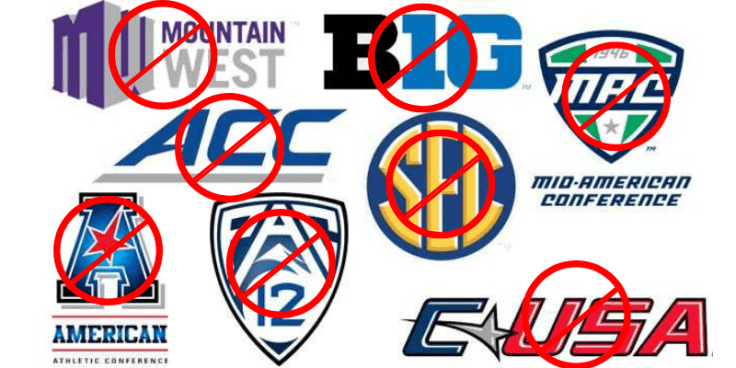
What if the FBS no longer had conferences?
I know. Killing conferences is bold. The Big Ten, since it’s original name of the Western Conference, organized in 1896, has over 120 years of history as a conference, even specifically playing football. Sorry. You can keep every other sport if it’s any reconciliation. The issue of scheduling is never going away in college football. Good small conference schools will always complain that they can only beat the teams they face and claim to deserve more opportunity for a championship. They usually don’t. But, good news! Now you can play whomever you want, you get to decide what rivalries you want to keep, everything is in the power of the athletic directors. You can keep playing the teams that were in your conference to informally keep it the same, that’s fine. But it would leave schools with no one to blame but themselves for their schedule not being good enough. It would allow us to potentially see on some mid-October Saturday afternoon matchups between Ohio State and Alabama, Florida and Oklahoma, USC and Texas, Michigan and Georgia, Notre Dame and LSU, etc., you get the point. Great teams could play other great teams in the regular season, or they could play decent teams and try to go undefeated playing teams like Mississippi State, Cal, Maryland, Northwestern, Boston College, Houston and Kansas State and see if that’s good enough to get a playoff birth. It would allow scheduling to become a strategy in college football. Could you imagine that? Talk show debates over whether a team who’s opponents seem to be in the top 50 but not the top 15 or a team who played 4 of the 20 best teams but their other 8 games were fairly easy had the better strength of schedule? Right now, teams play about one meaningful game in 3 or 4 out of conference games per year. In conference, they usually have 2-4 games against pretty good teams, and get to beat up on Rutgers, Vanderbilt, Kansas, Oregon State, North Carolina, or others, depending on which of the power 5 conferences they’re in. Without conferences, you can still schedule some easy games. You could even alternate them, so that you have a tough game one weak, then play an easier opponent the next, as a chance to recover between the more difficult contests. It’s unprecedented, sure, and the conferences have absolutely no reason to do it, the lost revenue no matter what happens with the redistributed wealth would scare the daylights out of them, so it’ll never happen. But just 30 years ago, the top 3 ranked teams in the postseason AP Poll were independent. Making your own schedule isn’t so bad.
If conferences were abolished for college football, there would need to be a lot of restructuring. The bowl eligibility requirements should be changed, the playoff format may need to be tweaked, and obviously with no more conference championship games, do we stick to 12 game seasons? Do we open it up to 13? Do we let teams choose 12 or 13 similarly to how teams played 11 or 12 for many years? Those are all possible options, but I like the idea of playing 13. It allows the easiest bowl eligibility change, where you still need to have at least a .500 record, but now that means 7-6 instead of 6-6, which will naturally create less bowl-eligible teams. In 2018, there were 10 6-6 teams that played in bowl games, along with 3 that didn’t, and 6-5 Southern Miss who also didn’t go to a bowl game. If we assume in a given year that half of 6-6 teams would get to 7-6 and bowl eligibility, that would cut these 14 teams to 7, which would be 3 less bowl-eligible teams than bowl games, meaning you could drop at least one bowl game and possibly have an opportunity for a 6-7 team with a tough schedule have an opportunity for postseason play. You could even go to a selection style for bowl games where teams are evaluated not purely off of record but rather a committee determines who is most deserving, like the NCAA Tournament selection for basketball, so that a team that goes 7-6 by beating teams like Arkansas State, North Texas, Georgia State, UTEP, and Ball State doesn’t go to a bowl game while a team that goes 6-7 beating teams like Cincinnati, Memphis, Wake Forest, Arizona, Baylor, etc. and losing to teams like Florida, Wisconsin, Oregon, Virginia Tech, could go to a bowl game having played a better schedule. If we abolish conferences, that also means abolishing conference tie-ins to bowl games. There could still be a way for De facto tie-ins, like having the bowl committee put a team from the midwest against a team from the west coast in the Rose Bowl, a team from the southeast against a team from the great plains/Texas in the Sugar Bowl, etc., but there won’t be the official conference arrangements for the games. The playoff has kind of ruined conference tie-ins to the New Years Six games anyway, and people don’t care nearly as much about the conference affiliations in smaller bowls.
What would the Playoff setup look like?
The playoff will remain at 4 teams for this conference-free FBS setup, with teams still being decided by a committee that will rank more than just those four teams, but we will cut the playoff committee’s rankings down to ten teams, as teams outside of the top ten don’t really matter for the playoff purposes, and fans and media members have at times wondered if the committee used the lower rankings to help bolster playoff resumes of teams they thought were deserving. With the committee only ranking ten teams, they stay focused on finding the best teams for the playoff, instead of worrying about the narrative of who should get in, simply picking who they believe the best teams are. The “best vs most deserving” argument takes a hit when there aren’t power 5 conference champions that they have to worry about leaving out, and they can simply pick the teams based on who they think would win a head-to-head matchup. Getting rid of conferences will take a lot of the politics out of college football and especially the playoff. Since the playoff started, every year we question if two teams from the same conference can get in, if a conference’s championship is basically a quarterfinal, if a one loss non-champion is better than a two loss champion, etc., a whole bunch of drama centered around conferences, specifically the power 5. These concerns wouldn’t matter in a conference-free environment. It wouldn’t matter if Alabama and Georgia might be two of the best four teams in the country, or Michigan and Ohio State, or Texas and Oklahoma, or Clemson and Florida State, or whomever else could be two great teams currently in the same conference that could both have a playoff argument. They won’t play each other in a championship game, they definitely won’t have played each other twice, and they can both be in without a problem if the committee thinks they deserve it. It takes out the concerns of putting two teams in from the same conference meaning that one more conference is left out. Conference affiliation wasn’t a big deal when there was a two-team championship format in the BCS era, largely because it wasn’t likely that the two best teams were in the same conference and a conference championship game would likely pit them together if they were. Of course, in 2011 when Alabama and LSU were the top two teams, they didn’t play in the SEC championship because they’re both in the West division, and that was the only time there was ever a regular-season rematch in the BCS Championship Game. Conference affiliation became a bigger deal when there were 4 teams invited to a playoff and 5 major conferences, especially as the first three years of the playoff featured 4 different conferences each year, leaving only one out. The last two years, 2 conferences have been left out, as the Big Ten and Pac 12 haven’t sent a team to the playoff since the 2016 season as the SEC put in 2 teams in 2017 (Alabama and Georgia) and an independent made the playoff in 2018 (Notre Dame). Despite this, the Big Ten was considered by many people to be the second best conference in 2018, behind only the SEC. So we can tell that overall conference talent doesn’t always reflect playoff teams, so the conferences themselves already aren’t important to the playoff, merely their structures are. When you take that away, largely teams would schedule their biggest rivalry games currently played the last week of the season as their 13th game. That includes games like Michigan-Ohio State, Washington-Washington State, Alabama-Auburn, Notre Dame-USC, Clemson-South Carolina, Georgia-Georgia Tech, LSU-Texas A&M, and Florida-Florida State, but saw Texas play Kansas and Oklahoma play (thrillingly this year) West Virginia, as the Red River Rivalry is played earlier in the year. Teams that play in those classic rivalries on the final Saturday of the season have combined for 15 of the 20 playoff spots, but we’ve yet to see both teams from any of those rivalries in the playoff. That could change soon with Florida, Michigan, Auburn, or USC getting a playoff bid sometime soon, something that would surprise few people, other than Florida and Auburn likely having to defeat Alabama to get into the playoff, and Alabama’s reign of terror on the SEC seems far from over even if Clemson overtakes them in terrorizing the rest of the league. That would again be less of a problem if conferences were dissolved for college football.
How would different types of teams set up their schedules?
The more recent years of independents can be used to demonstrate how major programs and smaller teams can all compete as independents. Notre Dame played a solid power 5 program schedule, which included two teams who played in their conference championship games in Northwestern and Pitt, as well as having 4 games against teams that were ranked when the Fighting Irish faced them in Michigan, Stanford, Virginia Tech and Syracuse. They also played some traditional powers in Florida State and USC, while having weaker opponents in Navy, Ball State, Vanderbilt and Wake Forest to round out their schedule (it’s worth noting Vandy and Wake Forest weren’t bad this year, they both played in bowl games this year). In an average year, a schedule that includes Michigan, Stanford, USC, Florida State and Virginia Tech would be a really good schedule, but other than Michigan none of those schools had great seasons this year. BYU is a better example of how a mid-tier team might set up a schedule as an independent. They played on the road against ranked opponents in Wisconsin, Washington and Utah (and beat Wisconsin), while also facing Arizona, Cal, and Boise State as other quality opponents (and Utah State, but they’re not normally considered quality), playing other independents UMass and New Mexico State, and mixed in Northern Illinois, Hawaii and McNeese State to fill out their schedule. A schedule that includes some big programs looking for a decent win, and some games that would provide an easier victory for the middle of the road program. Army had power 5 opponents in Oklahoma and Duke, but also played FCS teams Colgate and Lafayette, as well as hosting the transitioning Liberty Flames. Duke and Oklahoma would hand Army their only defeats of the year, but it was a confusing as they went to overtime with both Oklahoma and Miami of Ohio. New Mexico State and UMass played similar schedules, largely based on group of 5 teams near them, with NMSU playing mainly Mountain West and western Sun Belt teams while UMass played several CUSA and AAC teams, the biggest difference in their schedules being that UMass played two power 5 opponents, while NMSU played just one and faced Liberty twice, a very unusual scheduling move in college football. Both teams struggled even with these pretty easy schedules, with Massachusetts going 4-8 while New Mexico State compiled a 3-9 record on the year. These two serve more as examples for how smaller teams could still put together somewhat competitive schedules, not just serving as doormats for contending teams and needing to put FCS schools on their schedule to get wins as many currently do in their out of conference schedules.
Obviously not having conferences has its drawbacks. Conferences do a good job of pitting top teams against each other every year regardless of how teams set up their schedules, and teams scheduling games for 3+ years down the road can often lead to what looks like a good matchup being a letdown (Ohio State and TCU this season, for example). The structure of conferences generally helps differentiate good teams from great teams. But sometimes it takes great teams and can make them look worse than they really are. The Big Ten East having Ohio State, Michigan, and Penn State makes it challenging for three historic powers to all shine in the same season, let alone the fact that Michigan State has made the playoff from that same division. The SEC West is consistently stacked with NFL talent all over the place, and how much can Alabama, Auburn, LSU, and Texas A&M all produce in the same year when they all have 3 games against the others on that list? A few years ago when Louisville was really rolling, the ACC Atlantic had them, Clemson and Florida State for a stacked conference of their own. If Washington, Stanford, and Oregon were all at the peaks we’ve seen from them in the past 10 years at the same time, there would be a logjam of talent in the Pac 12 North. Conferences “help” the playoff system by working as eliminators. When there are multiple really good teams in a conference, playing each other will determine which one the playoff committee will consider to be playoff worthy. But 14 of 20 playoff teams have had a loss, so losing doesn’t eliminate a team, and one game almost can’t ruin your season (sorry to the 6 1-loss power 5 teams that have missed the playoff, including 2 of those 6 being Ohio State (’15 and ’18). So let’s get rid of conferences acting as eliminators, because that’s a very imperfect way of determining who the best teams are. Eliminating conferences would take a lot of restructuring, and may lead to even more elitism in college football, but it would free teams that could be really good if they weren’t stuck behind slightly better teams in their conference/division and may actually lead to more variance among champions and playoff contenders than college football has had in a long time. Parity is good for sports, and opportunities to increase parity should never be overlooked, even if they may seem strange and/or revolutionary ways of achieving this change. Abolishing conferences could trainwreck, leading to teams having weird schedules that see TV ratings decline and less fans in the stadiums, or it could prove to be a great way of making teams have a more equal chance at playing in bowl games and making the college football playoff. It might just be the best change college football has seen since the legalization of the forward pass. Until next time,
CM
Info courtesy of college-football-reference.
 Murphy's Field
Leave a comment